
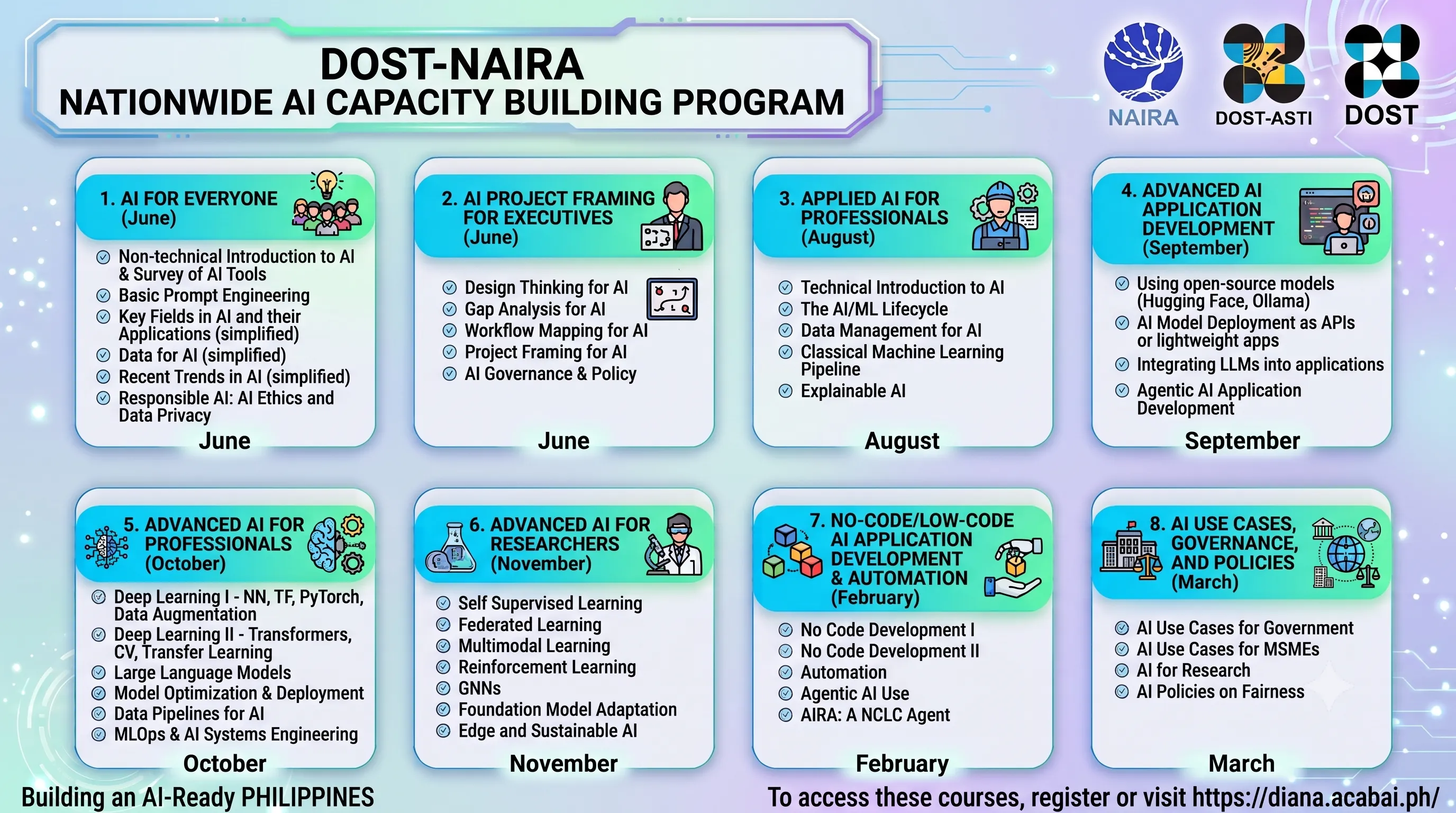
2026-06: The AI Advantage: Understanding AI and Why It Matters to Me and My Organization (Webinar 1)
A beginner-friendly session introducing AI concepts, practical tools, responsible use, and real-world applications across personal, organizational, and sectoral contexts.
Learning Goals:
- Introduce AI and its benefits to persons and organizations
- For MSMEs: Set the mindset for AI project development for participating MSMEs and student teams
- Teacher: Aunhel John Adoptante
- Teacher: Antonio Briza
- Teacher: Samuel Harrison Cerrudo
- Teacher: Justin Parreño
Learning Goals:
- Identify AI project opportunity within one's organization
- Apply Design Thinking framework for AI Project ideation and execution
- Formulate an AI Project Statement
- Teacher: Aunhel John Adoptante
- Teacher: Antonio Briza
- Teacher: Jonathan Cempron
- Teacher: Samuel Harrison Cerrudo
- Teacher: Gary Chris Lacdang
- Teacher: Justin Parreño
- Teacher: Julius Noah Sempio
A practical walkthrough of rapid prototyping tools and AI-enabled application development approaches using LLM and agentic AI use cases.
Learning Goals:
- Introduce rapid prototyping tools
- Provide walkthrough illustrations of LLM/Agentic use cases for AI application development
- Teacher: Aunhel John Adoptante
- Teacher: Samuel Harrison Cerrudo
- Teacher: Gary Chris Lacdang
- Teacher: Justin Parreño
A five-session introduction to how AI/ML systems are actually built — the concepts behind them, the data that sets their ceiling, the lifecycle around them, and the methods that explain what they decided.
Learning Goals:
- Place machine learning and deep learning within AI, tell the five types of learning apart by what each one needs from your data, and recognize the main computer vision and NLP tasks by what they take in and return
- Judge a dataset before trusting a model: where training data comes from, how the label unit changes across tables, text, images, audio, video, time series, satellite tiles and graphs, and why annotator agreement and the split key decide what your numbers mean
- Follow a project through the eight lifecycle stages and two loops that turn at different speeds, and set the success criterion, the baseline, and the deployment exposure level before the model exists
- Run a classical ML pipeline end to end — problem definition, exploratory analysis, cleaning, feature engineering, splitting, algorithm choice, evaluation, hyperparameter tuning, and deployment with monitoring — and know why classical methods still win on tabular data
- Explain a single prediction using LIME, SHAP, and DiCE, and tell intrinsic from post-hoc and local from global explanations when choosing a method
A hands-on session on building practical AI applications using open-source models, lightweight deployment approaches, LLM integration, and agentic workflows.
Learning Goals:
- Use open-source AI models through platforms and tools such as Hugging Face and Ollama
- Deploy AI models as APIs or lightweight applications
- Integrate large language models into software applications and workflows
- Design and develop agentic AI applications that can use tools and execute multi-step tasks
A hands-on session on deep learning, large language models, and the engineering practices that carry AI systems from training to production.
Learning Goals:
- Build and train neural networks in PyTorch, and apply data augmentation to improve how well a model generalizes
- Explain how convolutional and transformer architectures are applied to computer vision, and when transfer learning is the right choice
- Understand how large language models are built, adapted, and applied
- Weigh quantization, pruning, and distillation against latency, cost, and hardware constraints, and package a model for reliable serving
- Design a data pipeline from ingestion through feature serving, with the validation, lineage, and drift monitoring that keep it trustworthy
- Plan how an AI system is operated and evolved after deployment, using MLOps principles and maturity levels as a guide